 USD
 GBP
 CAD
 TTD
 EUR
 CHF
 DOP
 SGD
 MKD
 AUD
 HUF
 NZD
 TWD
 BGN
 PLN
 RUB
 HKD
 MXN
 SEK
 THB
 CZK
 TRY
 MYR
 ZAR
 PKR
 JPY
 ILS
 NOK
 CLP
 IDR
 PHP
 QAR
 AED
 KRW
 BRL
 GTQ
 SAR
 MAD
 UAH
 KWD
 VND
 LKR
 BMD
 ANG
 EGP
 BHD
 ARS
 ZMW
 COP
 AWG
 BZD
 DKK
 GYD
 ISK
 DJF
 BSD
 KES
 NIO
 NPR
 SRD
 MDL
 NGN
 BOB
 SZL
 BBD
 RSD
 FJD
 BDT
 SCR
 HNL
 CNY
 PEN
 MMK
 YER
 LAK
 OMR
 JMD
 KZT
 PGK
 MVR
 MGA
 MUR
 BWP
 KYD
 XPF
 KHR
 INR
 MWK
 MOP
 ETB
 PYG
 UGX
 GMD
 TZS
 SBD

wheelchair bearing guide
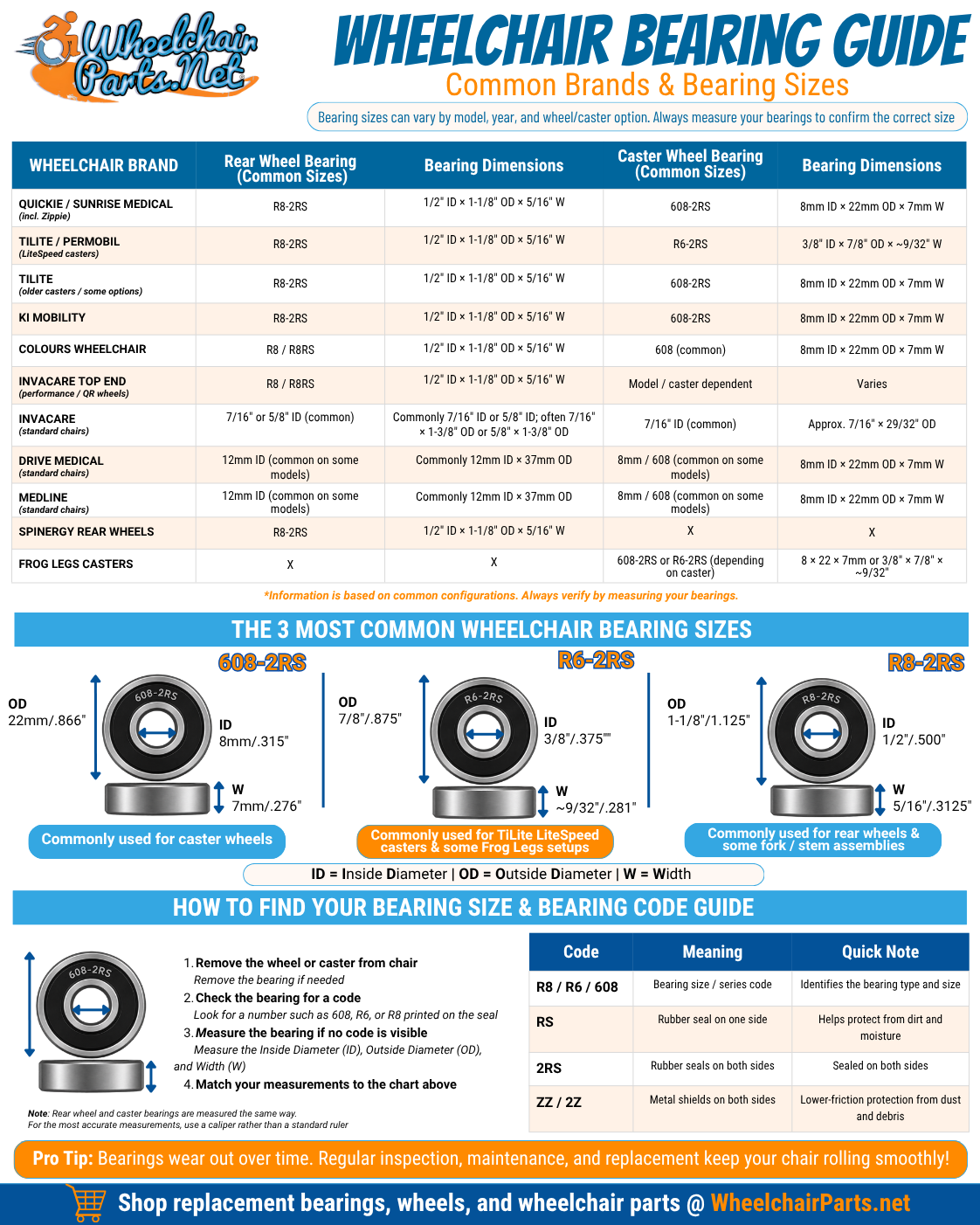
Wheelchair bearings may be small, but they play an important role in how smoothly your wheelchair rolls. Bearings are commonly found in rear wheels, caster wheels, and other moving components.
The correct bearing size is important because even a small difference can keep a bearing from fitting properly. Since bearing sizes can vary by wheelchair brand, model, year, wheel, and caster configuration, it is best to check the bearing itself and confirm its measurements before ordering a replacement.
What You’ll Learn in This Guide
- Common rear wheel and caster bearing sizes
- How bearing dimensions are measured
- What ID, OD, and width mean
- How to read common bearing codes
- What markings such as 2RS, ZZ, and 2Z mean
- How to check a bearing before ordering a replacement
Why Bearing Size Matters
A bearing that looks almost identical to your original can still be the wrong size. Bearings need to match several measurements in order to fit correctly.
The three main measurements are:
- ID, or Inside Diameter: The size of the opening through the center of the bearing.
- OD, or Outside Diameter: The full diameter across the outside of the bearing.
- Width: The thickness of the bearing from one side to the other.
The inside diameter needs to fit the axle or mounting hardware correctly, while the outside diameter needs to fit the wheel, hub, or caster. The width also affects how the bearing sits inside the component.
Close in Size Does Not Mean the Same Size
Measurements such as 12 mm and 1/2 inch may look very close, but they are not the same size and should not be treated as interchangeable.
Rear Wheel Bearings vs. Caster Bearings
Rear wheel bearings and caster wheel bearings are measured the same way, but they are often different sizes.
Rear wheel bearings are commonly sized around the wheelchair axle and rear wheel hub. Caster wheel bearings may use smaller metric or standard-size bearings depending on the caster and fork design.
There is no single bearing size used on every wheelchair. The exact bearing can vary by the wheel, caster, fork, axle, manufacturer, and model.
For that reason, always check the bearing code when one is visible and confirm the actual measurements before ordering.
How to Identify Your Bearing
Start by looking at the side of the bearing. Many bearings have a code printed or stamped onto the rubber seal or metal shield.
You may see markings such as:
R8, R6, 608, 2RS, ZZ, or 2Z
Some of these markings identify the bearing size, while others describe the type of seal or shield used on the bearing.
If the bearing code is missing, worn off, or difficult to read, you can identify the bearing by measuring it.
ID: Inside Diameter
Measure the opening through the center of the bearing.
OD: Outside Diameter
Measure across the full outside diameter of the bearing.
W: Width
Measure the thickness of the bearing from side to side.
For the most accurate measurements, use a caliper rather than a standard ruler. Bearings can differ by only a small amount, and those small differences matter when checking fit.
What Do 2RS, ZZ, and 2Z Mean?
These markings describe how the sides of the bearing are protected.
2RS means the bearing has rubber seals on both sides. These seals help protect the inside of the bearing from dirt, debris, and moisture.
ZZ and 2Z generally indicate metal shields on both sides of the bearing. These shields help protect the internal components from dust and debris.
When replacing a bearing, it is a good idea to match both the bearing size and the seal or shield style whenever possible.
Bearing Code vs. Bearing Size
Do not assume every letter or number printed on a bearing refers to its dimensions. Part of the code may identify the bearing size, while other letters may describe the seal, shield, or bearing design.
Before Ordering Replacement Bearings
Before purchasing a replacement bearing, check as much of the following information as possible:
- Inside diameter, or ID
- Outside diameter, or OD
- Bearing width
- Bearing code, if visible
- Axle or mounting diameter
- Whether the bearing is used in a rear wheel or caster wheel
- Seal or shield type
Wheelchair manufacturers may use different bearing configurations across models, production years, rear wheels, casters, and other components. Because of this, the wheelchair model alone may not always identify the correct bearing.
Whenever possible, compare the replacement bearing directly to the bearing being removed and confirm the measurements before ordering.
Quick Bearing Checklist
- Check the bearing for a printed code
- Measure the inside diameter
- Measure the outside diameter
- Measure the width
- Check whether it uses rubber seals or metal shields
- Confirm where the bearing is being used on the wheelchair
Ready to Find the Right Bearing?
Once you have confirmed the bearing measurements and type, compare those specifications with the replacement bearings available for your wheelchair.
SHOP WHEELCHAIR BEARINGS