 USD
USD
 GBP
GBP
 CAD
CAD
 TTD
TTD
 EUR
EUR
 CHF
CHF
 DOP
DOP
 SGD
SGD
 MKD
MKD
 AUD
AUD
 HUF
HUF
 NZD
NZD
 TWD
TWD
 BGN
BGN
 PLN
PLN
 RUB
RUB
 HKD
HKD
 MXN
MXN
 SEK
SEK
 THB
THB
 CZK
CZK
 TRY
TRY
 MYR
MYR
 ZAR
ZAR
 PKR
PKR
 JPY
JPY
 ILS
ILS
 NOK
NOK
 CLP
CLP
 IDR
IDR
 PHP
PHP
 QAR
QAR
 AED
AED
 KRW
KRW
 BRL
BRL
 GTQ
GTQ
 SAR
SAR
 MAD
MAD
 UAH
UAH
 KWD
KWD
 VND
VND
 LKR
LKR
 BMD
BMD
 ANG
ANG
 EGP
EGP
 BHD
BHD
 ARS
ARS
 ZMW
ZMW
 COP
COP
 AWG
AWG
 BZD
BZD
 DKK
DKK
 GYD
GYD
 ISK
ISK
 DJF
DJF
 BSD
BSD
 KES
KES
 NIO
NIO
 NPR
NPR
 SRD
SRD
 MDL
MDL
 NGN
NGN
 BOB
BOB
 SZL
SZL
 BBD
BBD
 RSD
RSD
 FJD
FJD
 BDT
BDT
 SCR
SCR
 HNL
HNL
 CNY
CNY
 PEN
PEN
 MMK
MMK
 YER
YER
 LAK
LAK
 OMR
OMR
 JMD
JMD
 KZT
KZT
 PGK
PGK
 MVR
MVR
 MGA
MGA
 MUR
MUR
 BWP
BWP
 KYD
KYD
 XPF
XPF
 KHR
KHR
 INR
INR
 MWK
MWK
 MOP
MOP
 ETB
ETB
 PYG
PYG
 UGX
UGX
 GMD
GMD
 TZS
TZS
 SBD
SBD


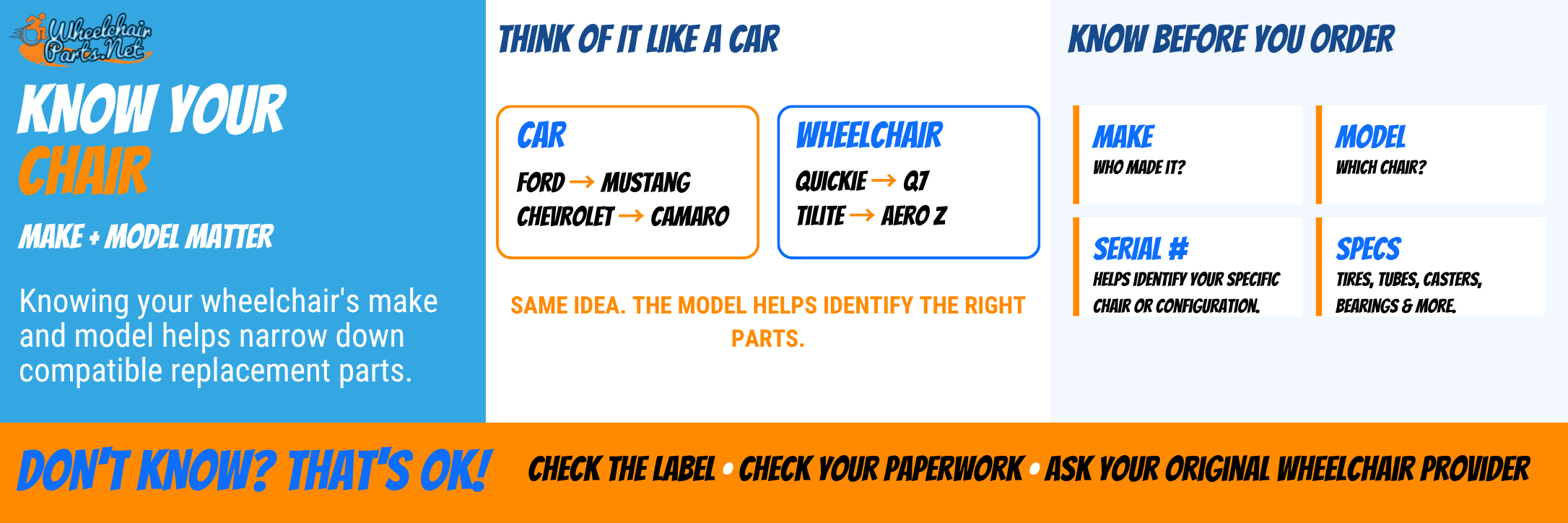
Think about ordering a replacement part for a car.
You probably wouldn’t walk into an auto parts store and simply say, “I need a part for my car.”
They’d need more information.
Ford → Mustang
Chevrolet → Camaro
Dodge → Charger
Knowing the make and model helps narrow down which parts were designed for that specific vehicle.
Ordering wheelchair parts works in a similar way.
Knowing that you have a manual wheelchair, power wheelchair, or mobility scooter is a good start, but it often isn’t enough to identify the replacement parts you need.
Knowing your wheelchair’s manufacturer, model, and serial number when available can make finding compatible parts much easier.
Make vs. Model: What’s the Difference?
The make is the manufacturer or brand that made your wheelchair.
The model is the specific wheelchair they produced.
For example:
Quickie → Q7
TiLite → Aero Z
Invacare → Tracer EX2
Drive Medical → Cruiser III
Just like car manufacturers produce many different models, wheelchair manufacturers do too.
Two chairs from the same manufacturer can use very different parts, so knowing the brand alone may not be enough.
Why Does Your Wheelchair Model Matter?
Wheelchairs are not built around one universal set of parts.
Depending on the chair, differences can include:
- Rear wheel and tire sizes
- Inner tube sizes and valve types
- Bearings
- Axles
- Casters and caster forks
- Wheel locks
- Armrests and arm pads
- Footrests and footplates
- Upholstery
- Mounting hardware
Even parts that look nearly identical can differ in size, mounting style, or other specifications.
Your wheelchair’s make and model gives you a much better starting point when searching for replacement parts.
“But I Know My Wheelchair Has 24-Inch Wheels”
That’s useful information, but it still may not be enough.
It’s similar to saying your car has 18-inch wheels. That tells a parts supplier something, but it doesn’t tell them whether you drive a Mustang or a Charger.
Wheelchair tires and tubes can be especially confusing because commonly used wheel sizes do not always tell the whole story.
Two tires may both be called “24-inch” but use different sizing standards or dimensions. Inner tubes can also vary by size and valve type.
That’s why it’s important to check the full markings and specifications on your existing tire or tube whenever possible.
Where Can I Find My Wheelchair’s Make and Model?
Start by looking for a manufacturer label or serial number sticker on the wheelchair.
The location varies by manufacturer, so check the frame and areas around or underneath the seating system.
Look for:
Manufacturer
Model or model number
Serial number
If you’re unsure which number is which, take a clear photo of the entire label.
Don’t Know? Ask!
You do not have to figure everything out on your own.
If you purchased your wheelchair through a mobility dealer, DME provider, rehabilitation provider, or another wheelchair supplier, contact them and ask for the information associated with your chair.
You can simply say:
“I’m trying to order replacement parts for my wheelchair. Can you tell me the manufacturer, model, and serial number of the chair I received from you?”
If they have your original equipment records, they may be able to help identify exactly what you have.
Knowing this information can help you better understand and maintain the equipment you rely on.
Keep Your Wheelchair Information Handy
Once you identify your wheelchair, save the information somewhere easy to find.
Consider keeping:
Manufacturer:
Model:
Serial Number:
Year received:
Rear tire size:
Caster size:
Other important specifications:
Save it in your phone, take a photo of the label, or keep it with your wheelchair paperwork.
Know Your Chair Before You Order
Knowing your wheelchair’s make, model, serial number, and relevant specifications can make ordering replacement parts much easier.
And if you do not know that information yet, that’s okay.
Check the label. Check your paperwork. Ask the provider who supplied your chair.
At WheelchairParts.net, we want wheelchair users and caregivers to feel more confident understanding their equipment and finding the replacement parts they need.