 USD
 GBP
 CAD
 TTD
 EUR
 CHF
 DOP
 SGD
 MKD
 AUD
 HUF
 NZD
 TWD
 BGN
 PLN
 RUB
 HKD
 MXN
 SEK
 THB
 CZK
 TRY
 MYR
 ZAR
 PKR
 JPY
 ILS
 NOK
 CLP
 IDR
 PHP
 QAR
 AED
 KRW
 BRL
 GTQ
 SAR
 MAD
 UAH
 KWD
 VND
 LKR
 BMD
 ANG
 EGP
 BHD
 ARS
 ZMW
 COP
 AWG
 BZD
 DKK
 GYD
 ISK
 DJF
 BSD
 KES
 NIO
 NPR
 SRD
 MDL
 NGN
 BOB
 SZL
 BBD
 RSD
 FJD
 BDT
 SCR
 HNL
 CNY
 PEN
 MMK
 YER
 LAK
 OMR
 JMD
 KZT
 PGK
 MVR
 MGA
 MUR
 BWP
 KYD
 XPF
 KHR
 INR
 MWK
 MOP
 ETB
 PYG
 UGX
 GMD
 TZS
 SBD

Parts of a Manual Wheelchair Explained
Manual wheelchairs are made up of many individual components that work together to provide mobility, support, comfort, and control. Learning the names of these parts makes it easier to understand your chair, identify replacement parts, and know what to look for when something needs maintenance or replacement.
Wheelchair designs can vary by manufacturer and model, but many manual wheelchairs share the same basic components.
What You’ll Learn in This Guide
- The main parts of a manual wheelchair
- What each component does
- The difference between rear wheels, casters, and caster forks
- What handrims / pushrims, axles, and bearings do
- How wheel locks, armrests, footrests, and upholstery fit into the chair
- Why wheelchair parts can vary by manufacturer and model
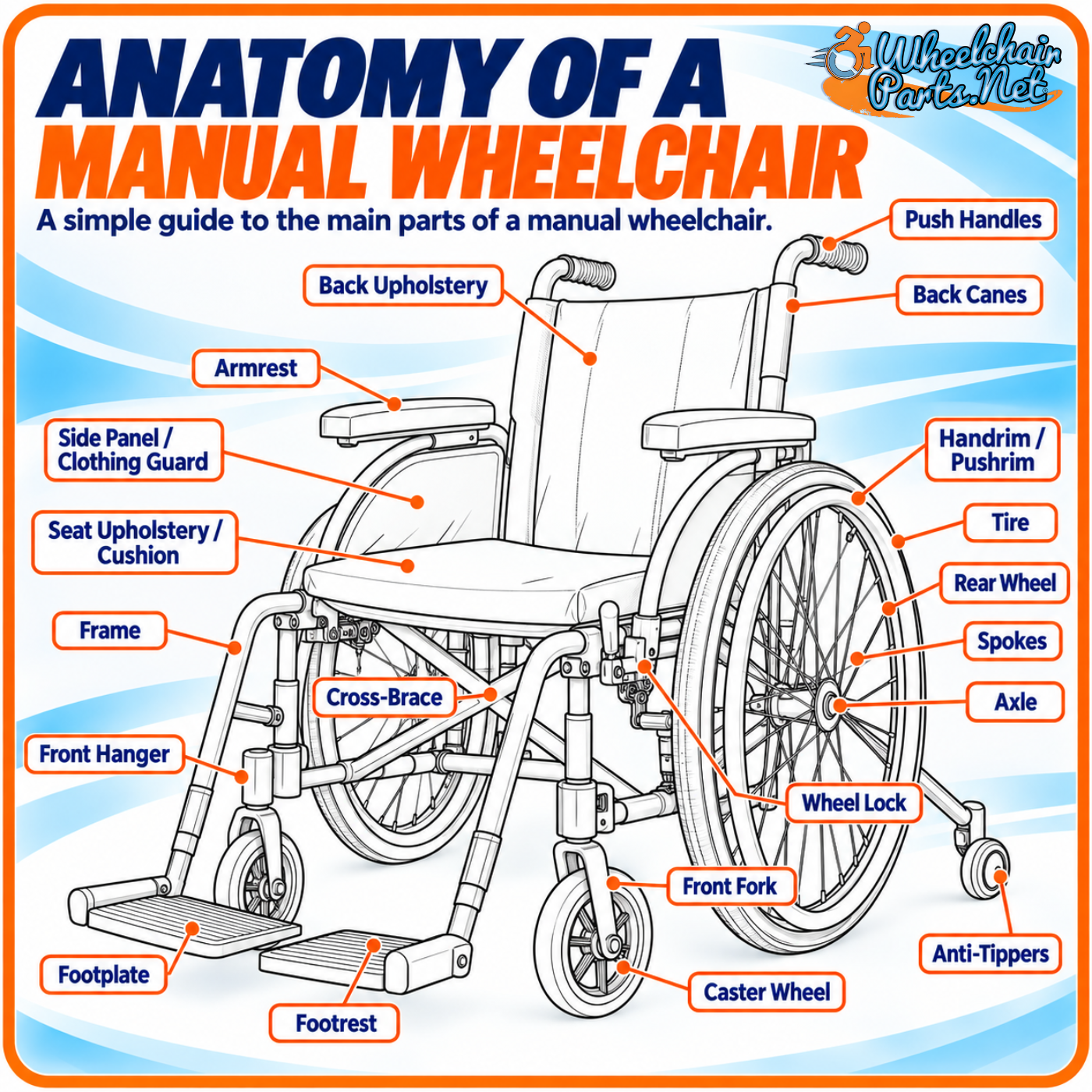
Frame
The frame is the main structure of the wheelchair and supports the seat, wheels, armrests, foot supports, and other components.
Manual wheelchair frames generally fall into two broad styles:
- Folding frames, which typically use a cross-brace beneath the seat so the chair can fold inward
- Rigid frames, which use a more fixed structure with fewer folding components
Frame shape, tubing size, and mounting points can vary between wheelchair models.
Rear Wheels
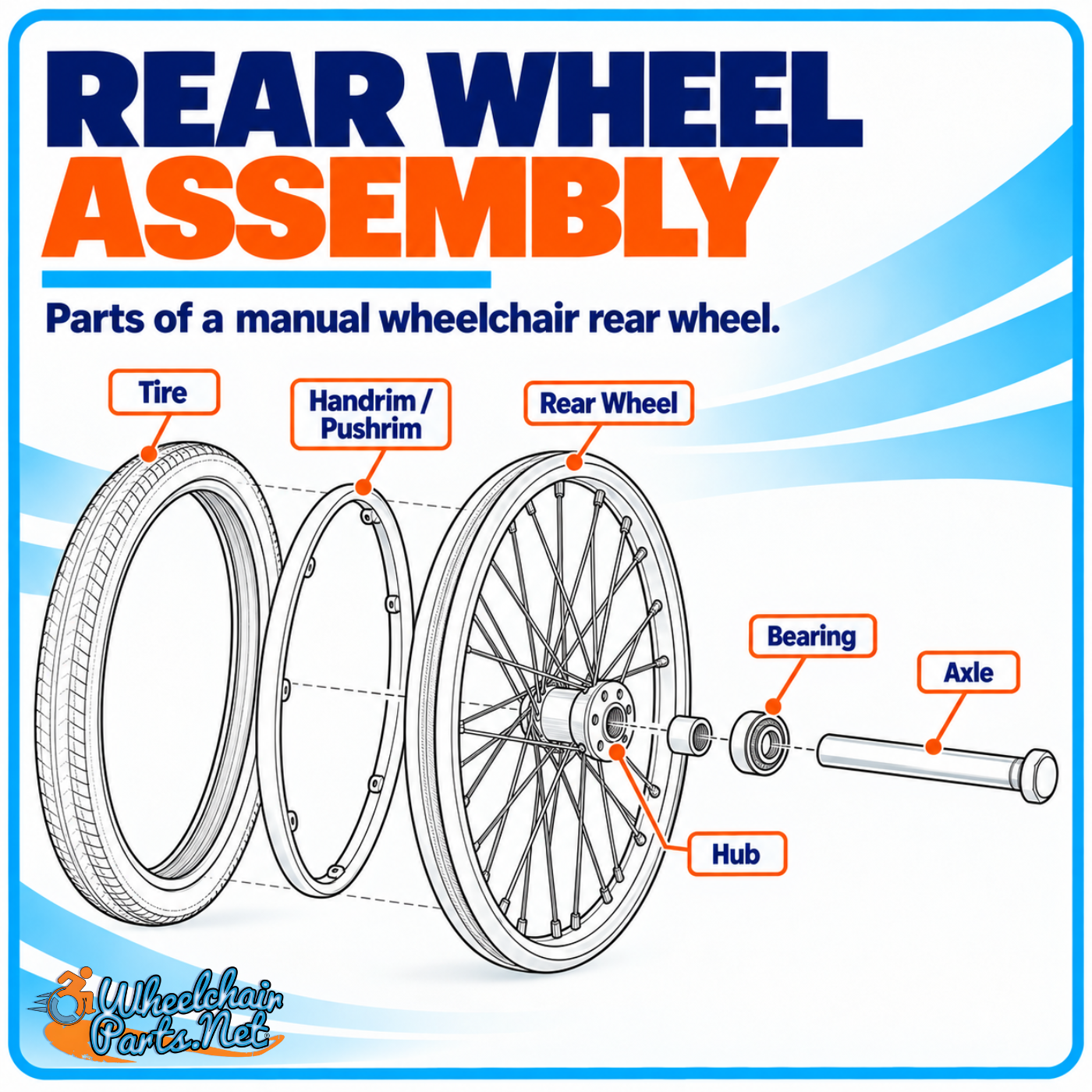
The rear wheels are the large wheels located on either side of the wheelchair. On self-propelled manual wheelchairs, the user moves the chair by pushing on the handrims attached to these wheels.
Rear wheels can vary by diameter, hub design, bearing size, axle type, spoke or mag-wheel construction, and tire size.
Handrim / Pushrim
The handrim, also commonly called a pushrim, is the ring mounted alongside the rear wheel.
It gives the wheelchair user a surface to grip and push without needing to propel the chair directly from the tire.
Handrims can vary in diameter, material, coating, grip style, and mounting method.
Tires
Wheelchair tires provide traction and can affect ride comfort and how easily the chair rolls.
Common tire types include:
- Pneumatic
- Solid
- Foam-filled or flat-free
Always confirm the tire and rim size before ordering a replacement.
Axles
The axle connects the rear wheel to the wheelchair.
Common axle styles include quick-release axles, which allow the wheel to be removed by pressing a release button, and fixed axles, which remain secured to the chair using hardware.
The axle needs to fit correctly through the wheel bearing, so axle diameter is an important measurement when replacing wheels or axles.
Bearings
Bearings are small components that help the wheels and casters rotate smoothly.
When replacing a bearing, the main measurements to check are the inside diameter, outside diameter, and width.
- ID: Inside Diameter
- OD: Outside Diameter
- W: Width
Bearing sizes can vary by wheelchair model, wheel, caster, and manufacturer.
Casters
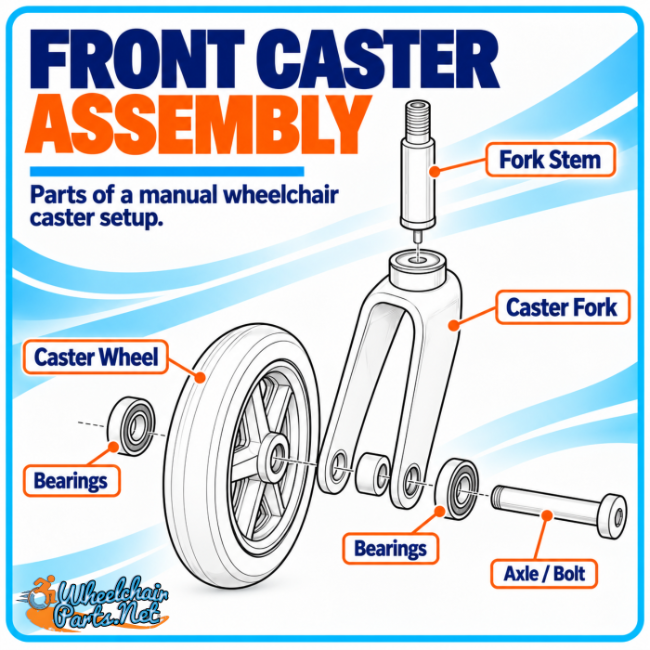
Casters are the smaller wheels located at the front of most manual wheelchairs. They help the wheelchair turn, steer, and maneuver.
Casters can vary in diameter, width, material, tread style, hub width, and bearing size.
Caster Forks
The caster fork holds the caster wheel and connects it to the wheelchair frame.
Caster forks can vary in width, length, axle size, mounting style, and available clearance.
Wheel Locks
Wheel locks secure the rear wheels while the wheelchair is stationary.
They are sometimes called brakes, but standard wheelchair wheel locks are generally designed to hold the chair in place rather than slow it while moving.
Common styles include:
- Push-to-lock
- Pull-to-lock
- Scissor-style wheel locks
Armrests
Armrests provide support for the user’s arms and may also assist with positioning or transfers.
Common styles include fixed, removable, flip-back, and height-adjustable armrests.
The padded portion is commonly called the arm pad.
Seat Upholstery
Seat upholstery forms the seating surface of many manual wheelchairs.
Depending on the wheelchair, it may consist of flexible upholstery attached directly to the frame or be used underneath a separate wheelchair cushion.
Back Upholstery
Back upholstery supports the user’s back and is usually attached between the wheelchair’s rear frame posts or back canes.
Some wheelchairs use standard sling-style upholstery, while others may use adjustable-tension or specialized back systems.
Push Handles and Back Canes
Push handles are located at the upper rear of many manual wheelchairs and allow an attendant or caregiver to push the chair.
Back canes are the vertical frame tubes that support the wheelchair’s back upholstery. On many chairs, the push handles are attached to the back canes.
Side Panels / Clothing Guards
Side panels or clothing guards sit between the user and the rear wheels.
They help protect clothing and personal items from rubbing against or becoming caught in the wheels.
Cross-Brace
On many folding manual wheelchairs, the cross-brace is the X-shaped structure underneath the seat.
It allows the wheelchair to fold inward while helping support and stabilize the frame when the chair is open.
Front Hangers
The front hanger connects the footrest or legrest assembly to the wheelchair frame.
You may also hear this part called a hanger or legrest hanger.
Hangers may be fixed, removable, or swing-away depending on the chair.
Footrests and Footplates
Footrests support the user’s feet and lower legs.
The footplate is the platform where the user’s foot rests. Footplates may fold upward and can vary in size, shape, material, and mounting style.
Anti-Tippers
Anti-tippers extend behind the wheelchair and are designed to help reduce the risk of the chair tipping backward.
They usually attach to the lower rear portion of the frame and may include small wheels or rollers.
Not Every Wheelchair Uses the Same Parts
Two wheelchairs may look very similar and still use different components.
- Manufacturer
- Model
- Production year
- Tubing size
- Mounting style
- Bearing size
- Axle diameter
- Hub width
- Wheel or caster configuration
That is why identifying the part and confirming its measurements is often just as important as knowing the wheelchair make and model.
Ready to Find Replacement Parts?
Once you know what the component is called, you can compare its measurements, mounting style, and specifications to help narrow down the correct replacement.