 USD
USD
 GBP
GBP
 CAD
CAD
 TTD
TTD
 EUR
EUR
 CHF
CHF
 DOP
DOP
 SGD
SGD
 MKD
MKD
 AUD
AUD
 HUF
HUF
 NZD
NZD
 TWD
TWD
 BGN
BGN
 PLN
PLN
 RUB
RUB
 HKD
HKD
 MXN
MXN
 SEK
SEK
 THB
THB
 CZK
CZK
 TRY
TRY
 MYR
MYR
 ZAR
ZAR
 PKR
PKR
 JPY
JPY
 ILS
ILS
 NOK
NOK
 CLP
CLP
 IDR
IDR
 PHP
PHP
 QAR
QAR
 AED
AED
 KRW
KRW
 BRL
BRL
 GTQ
GTQ
 SAR
SAR
 MAD
MAD
 UAH
UAH
 KWD
KWD
 VND
VND
 LKR
LKR
 BMD
BMD
 ANG
ANG
 EGP
EGP
 BHD
BHD
 ARS
ARS
 ZMW
ZMW
 COP
COP
 AWG
AWG
 BZD
BZD
 DKK
DKK
 GYD
GYD
 ISK
ISK
 DJF
DJF
 BSD
BSD
 KES
KES
 NIO
NIO
 NPR
NPR
 SRD
SRD
 MDL
MDL
 NGN
NGN
 BOB
BOB
 SZL
SZL
 BBD
BBD
 RSD
RSD
 FJD
FJD
 BDT
BDT
 SCR
SCR
 HNL
HNL
 CNY
CNY
 PEN
PEN
 MMK
MMK
 YER
YER
 LAK
LAK
 OMR
OMR
 JMD
JMD
 KZT
KZT
 PGK
PGK
 MVR
MVR
 MGA
MGA
 MUR
MUR
 BWP
BWP
 KYD
KYD
 XPF
XPF
 KHR
KHR
 INR
INR
 MWK
MWK
 MOP
MOP
 ETB
ETB
 PYG
PYG
 UGX
UGX
 GMD
GMD
 TZS
TZS
 SBD
SBD


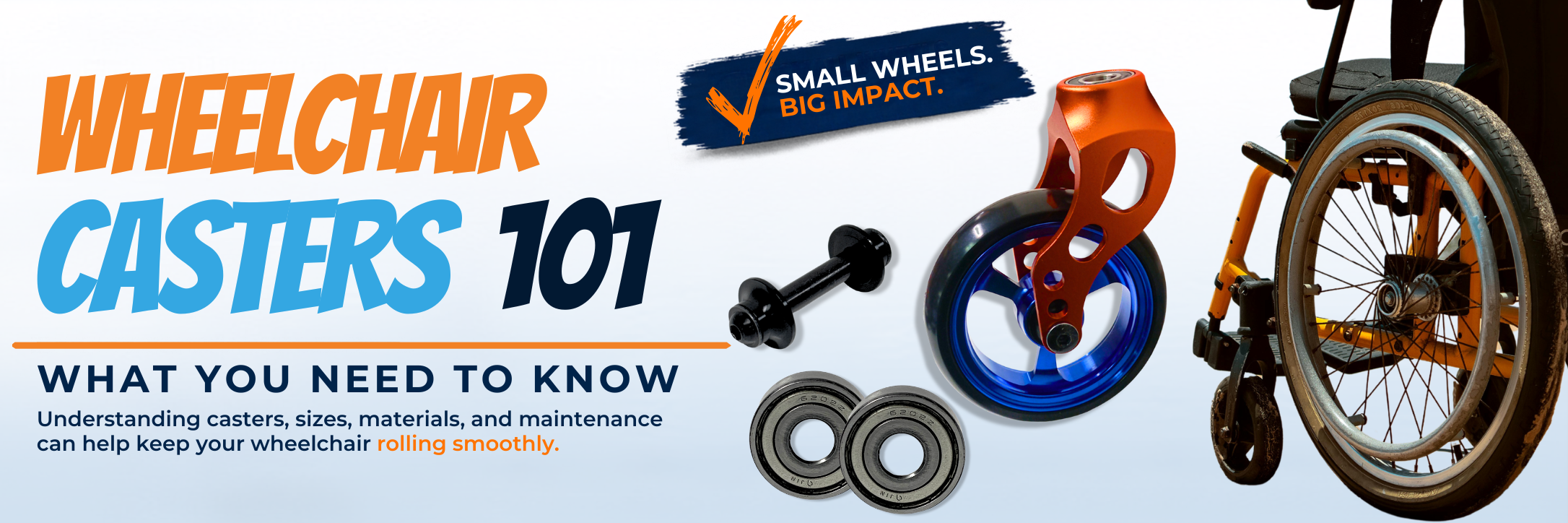
Wheelchair casters may be small, but they play a big role in how your wheelchair moves, turns, and handles different surfaces.
Whether you're replacing worn casters or exploring different options for your chair, understanding a few basics can make choosing the right replacement much easier.
What Are Wheelchair Casters?
Casters are the smaller wheels typically located at the front of a manual wheelchair. They swivel as you move, allowing the chair to turn and change direction.
The caster assembly generally includes the caster wheel, bearings, axle hardware, and caster fork that connects the wheel to the wheelchair.
Why Does Caster Size Matter?
Wheelchair casters come in a variety of diameters and widths, and changing those dimensions can affect how a chair feels and performs.
In general, smaller casters can feel more responsive and maneuverable on smooth surfaces, while larger casters may roll over cracks, bumps, and uneven surfaces more easily.
Width and tire material can also affect ride feel, traction, and rolling performance.
Because caster size can affect wheelchair setup and geometry, don't assume a different size will work simply because it fits inside the fork.
Solid, Pneumatic, and Semi-Pneumatic Casters
Just like rear wheelchair tires, casters can use different tire styles.
Solid casters require very little maintenance and eliminate the possibility of flats.
Pneumatic casters use air-filled tires and can provide additional cushioning, but they require proper inflation and can puncture.
Semi-pneumatic casters are designed with a hollow tire construction that provides some cushioning without requiring air.
The right option depends on your wheelchair, environment, and personal preference.
Don't Forget About the Caster Fork
The wheel is only one part of the caster assembly.
Caster forks come in different widths, lengths, mounting configurations, and axle positions. The fork needs to provide the proper clearance for the caster wheel while also being compatible with the wheelchair.
If you're replacing only the caster wheel, check that the new wheel is compatible with your existing fork and hardware.
Signs Your Casters May Need Attention
Casters experience plenty of everyday wear. It may be time to inspect them if you notice:
- Cracks, chunks, or flat spots in the tire
- Excessive wobbling
- Uneven wear
- Difficulty swiveling
- Grinding or unusual noises
- A caster that doesn't roll smoothly
Sometimes the caster itself is worn, while other issues may involve the bearings, axle hardware, fork, or another part of the wheelchair.
Before Ordering Replacement Casters
Don't rely on appearance alone. Two casters can look nearly identical and still have important differences.
Before ordering, check information such as:
- Caster diameter
- Caster width
- Hub width
- Bearing size
- Axle or bolt size
- Existing fork clearance
- Wheelchair make and model
If you're unsure, keeping your original caster available for comparison can be extremely helpful.
The Bottom Line
Casters have a major impact on how your wheelchair rolls and maneuvers, making them an important part of everyday wheelchair maintenance.
Understanding your current caster setup and checking the specifications before ordering can help you find a replacement that works properly with your chair.
At WheelchairParts.net, we carry a variety of wheelchair casters, caster forks, bearings, and replacement components to help keep your wheelchair rolling smoothly.